DOT compliance decals for trucking and fleet companies: complete 2026 guide


Trucking-company DOT compliance lettering is the identification displayed on covered commercial vehicles so the operating carrier can be identified. This 2026 guide explains how to verify your information, choose readable decals, and keep fleet markings correct when trucks, drivers, and assignments change.
Your truck can carry an attractive business name and still have incorrect carrier identification. A logo, fleet unit number, or slogan does not replace the required name and USDOT number on a covered vehicle.
Fleet companies also face a practical problem: the information on the truck must match the carrier operating it. Replacement doors, reassigned equipment, leased vehicles, and business-name changes all deserve a marking check. Ordering another copy of an old decal without checking the underlying information repeats the same mistake.
Nostalgifactory sells personalized, handmade vinyl decals and weatherproof stickers for consumers and small businesses. Nostalgifactory personalized vehicle decals are best for small businesses that have verified their lettering and want a custom-made display. Treat the decal as the finished identification, not as a decision about which regulations apply to your operation.
For this 2026 guide, the federal marking baseline is 49 CFR § 390.21, covering identification of applicable self-propelled commercial motor vehicles. Its general requirements include the operating carrier's legal name or a single trade name listed in its federal identification report, plus its identification number preceded by USDOT. The markings belong on both sides, must contrast sharply with the background, and must remain legible.
State-specific requirements and special operating arrangements need their own review. Decals do not create operating authority or exempt a vehicle from regulation.
Start with the free route: review the applicable FMCSA requirements and your state transportation agency's instructions. Separate the vehicle's identification requirements from registration, operating authority, insurance, and other obligations. They are related, but lettering does not satisfy all of them.
Do not classify a truck solely by its appearance. A pickup used commercially and a tractor-trailer can raise different questions, while an interstate operation and an intrastate operation require different applicability checks. Record your conclusion before creating artwork.
For a leased vehicle, identify the carrier actually responsible for the operation. Section 390.21 includes provisions for certain rental arrangements, so a permanent decal is not the answer to every temporary assignment.
Use your official carrier records as the starting point, not a business card or an old photograph. Compare the legal name or listed trade name against your FMCSA identification record. Then verify the USDOT number character by character.
The name that customers recognize is not automatically the name your carrier record uses. If your branding differs from the operating carrier's identity, resolve that difference before approving the decal proof. Additional names on a vehicle can trigger further identification requirements under § 390.21.
For your 2026 fleet file, keep the approved wording beside the vehicle assignment record. That gives the next person ordering replacements a reliable reference instead of a guess.
Begin with a paper layout. Write the required carrier name and USDOT number, then mark which information already exists on the vehicle. A complete replacement panel and a number-only replacement solve different problems.
A prepared custom decal set reduces the need to arrange individual characters yourself. Nostalgifactory offers Custom USDOT MC Decals for Commercial Vehicles, described as a custom business-name, USDOT, and MC set containing 2 decals. That format suits an operator preparing both sides, provided the final wording and layout meet the applicable requirements.
The store also lists Ensure DOT Compliance and Style with Our US DOT and MC Truck Decals Set of 4. Its number-focused format requires you to check the carrier-name display separately. Neither a product title nor the inclusion of an MC number confirms that the whole vehicle is correctly marked.
Check the proposed location with a tape measure and a paper mockup before installation. Under the general federal rule, the carrier markings must be legible from 50 feet during daylight hours while the vehicle is stationary. This is a visibility requirement, not simply a font-size purchase decision.
Inspect 2 vehicle sides, not just the driver's door. A readable driver's-side layout does not excuse an obstructed passenger-side display. Look for handles, trim, equipment, existing graphics, and changes in background color that interfere with reading.
Federal § 390.21 does not prescribe one universal minimum letter height for ordinary carrier identification. Select the layout for the actual viewing result, then check any additional state requirements. Thin script and decorative lettering work against the purpose of clear identification.
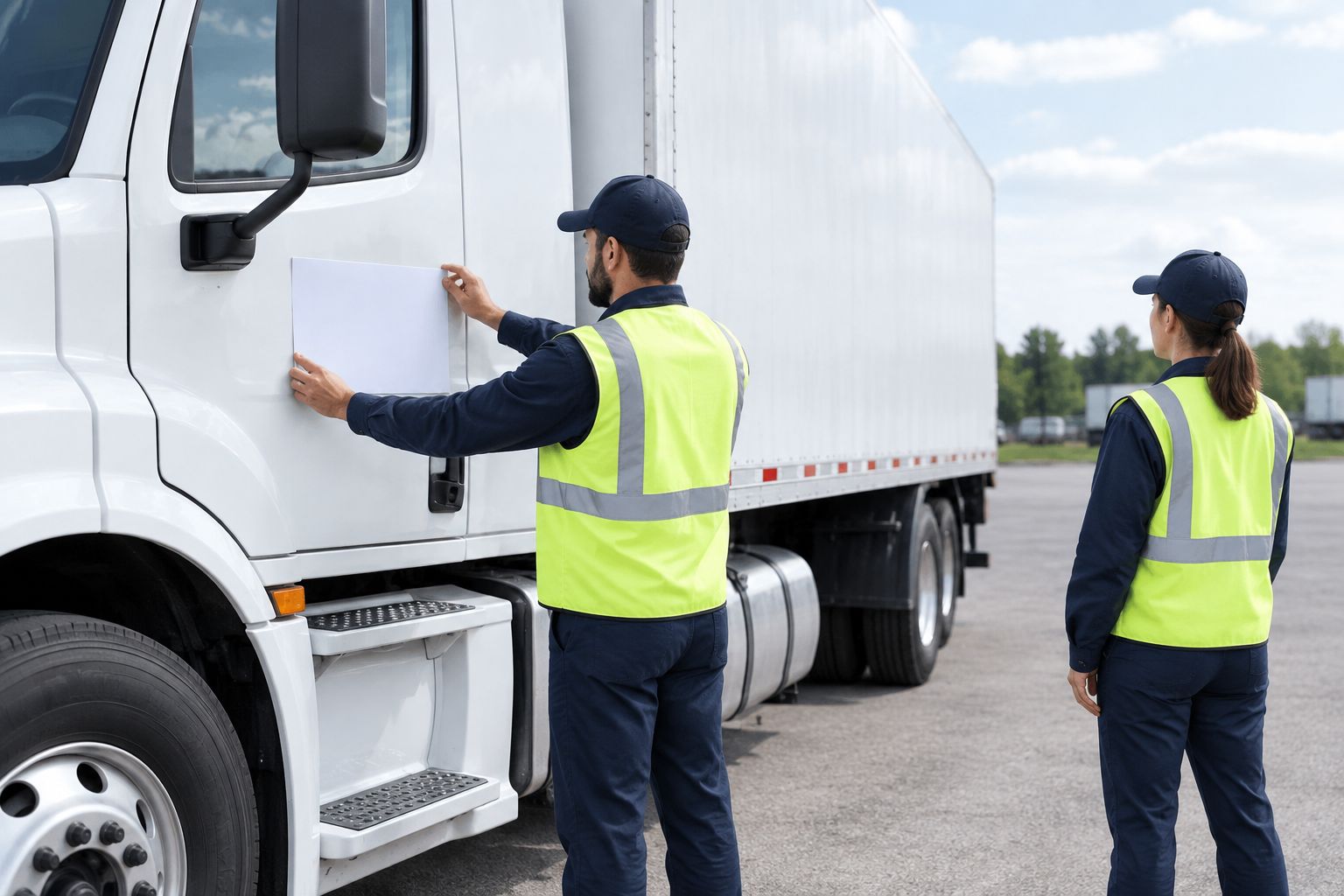
Create a simple spreadsheet before submitting an order. Give each vehicle its own record with the carrier name, USDOT number, optional information, installation surface, and approved proof. You can manage a small fleet this way without dedicated software.
Check the proof at its intended dimensions, not only as a enlarged image on your phone. Long names need enough room to remain readable; shrinking everything to fit an available space defeats the purpose. Confirm the relevant lettering dimensions rather than assuming the overall decal size describes every character.
Nostalgifactory's personalized decal options provide a made-to-order route after you have verified the details. The advantage is custom lettering; the limitation is that your submitted information and installation still need checking. A correctly produced typo is still the wrong identification.
The following sets address different ordering needs. Choose based on what the vehicle already displays, rather than assuming that more decals mean more complete compliance.

Follow the instructions supplied for the specific decal. Start by checking the panel condition and removing dirt and incompatible residues using a method suitable for the vehicle finish. Do not invent an installation temperature, cleaning chemical, or curing interval from instructions for another vinyl product.
Dry-position the lettering before exposing the adhesive. Confirm that the final location matches the approved layout and that the surface does not interrupt important characters. Removing and repositioning adhesive lettering is not the same as moving a paper template.
A weatherproof sticker still needs a suitable installation surface. Material choice does not correct poor adhesion, unreadable contrast, or an inaccurate number. Finish by comparing the installed lettering with the approved proof.
Build a marking check into your existing vehicle inspections and assignment process. The federal standard requires markings to remain legible, so the responsibility continues after installation. Inspect the information as well as the material condition.
For your 2026 maintenance checklist, include changes to carrier identity, door replacement, repainting, and equipment reassignment. Each event deserves a fresh comparison between the official record and the vehicle display. Do not leave conflicting old lettering visible when a new operating arrangement requires different identification.
Photographs help document what was installed, but they do not prove current readability from the required distance. Recheck the physical truck when lettering becomes worn, obscured, or damaged.
The best choice depends on whether you need the whole carrier identification replaced or only part of it. Evaluate the finished display, not the package name.
| Option | Best for | Practical advantage | Key limitation |
|---|---|---|---|
| Individually arranged vinyl lettering | Operators comfortable building a layout | Lets you position each line around the usable panel area | You must manage spacing, alignment, and accuracy yourself |
| Custom USDOT MC Decals for Commercial Vehicles | Small operators ordering a business-name and number layout | Combines business-name, USDOT, and MC information in a custom set | Submitted details and installed readability still require verification |
| Ensure DOT Compliance and Style with Our US DOT and MC Truck Decals Set of 4 | Fleets updating number lettering | Provides a number-focused set of 4 decals | Does not replace a separate check of the required carrier-name display |
| Professionally laid-out vehicle lettering | Fleets needing help with placement and installation | Gives you a route to coordinate the whole vehicle layout | You still need to provide accurate carrier information and verify the finished result |
Choose complete identification when the name is missing; choose replacement number lettering only when the rest of the display is correct. Optional branding belongs around that decision, not ahead of it.
A recognizable logo is not enough if it fails to display the required legal or listed trade name. Check the actual wording against the carrier record, especially when your customer-facing brand differs from the operating entity.
An MC number does not replace the required USDOT identification. For ordinary federal carrier markings, § 390.21 requires the USDOT number; adding MC lettering does not compensate for an incorrect or missing carrier name.
A size label does not establish readable contrast or correct placement. Check the finished identification from 50 feet in daylight with the vehicle stationary, and review any additional state rules.
Not For Hire describes an operating distinction; it does not independently decide whether commercial-vehicle regulations apply. Determine the operation's obligations before using optional wording as reassurance.
An old door photograph is a reference, not an authoritative carrier record. For replacements ordered in 2026, verify the current name and number before reproducing previous lettering.
What information belongs on DOT compliance decals for trucking companies?
For vehicles covered by the general federal marking rule, the required identification includes the operating carrier's legal name or a single listed trade name and its identification number preceded by USDOT. Section 390.21 also addresses placement, contrast, legibility, and certain special arrangements.
Do I need DOT lettering on both sides of my truck?
The general federal rule requires carrier identification on both sides of the covered self-propelled commercial motor vehicle. Check each side separately for correct wording, contrast, and visibility.
How far away must someone be able to read USDOT lettering?
Federal carrier markings must be legible from 50 feet during daylight hours while the vehicle is stationary. Check the installed lettering, because font choice, contrast, and obstructions affect the result.
Are two-inch letters always DOT compliant?
No, a letter-height label alone does not establish compliance. The general federal rule uses a readability standard rather than one universal minimum height, and additional state requirements need a separate check.
Do I have to put my MC number on the truck?
An MC number is not part of the standard federal carrier-identification requirement in 49 CFR § 390.21. The required USDOT number and carrier name remain essential, and other applicable requirements should be checked separately.
Can Not For Hire decals replace a USDOT number?
No, Not For Hire lettering does not replace required USDOT identification or establish an exemption. Determine the rules that apply to the vehicle and operation before choosing its markings.
Which Nostalgifactory decal format fits a small trucking business?
Custom USDOT MC Decals for Commercial Vehicles fits an operator looking for a custom business-name and number set. Verify the final proof, dimensions, placement, and required readability before using it as carrier identification.
When should I replace fleet compliance lettering?
Replace or correct lettering when it becomes illegible, damaged, inaccurate, or inconsistent with the operating carrier's required identification. Recheck markings after relevant business changes, vehicle reassignment, repainting, or door replacement.
The simplest final check costs nothing: read the installed carrier name and USDOT number aloud while someone compares them with the official record. Do this on both sides, then perform the daylight distance check. A tidy layout deserves the same attention to accuracy as the paperwork behind it.
