Best Company Decals for Storefronts in 2026


Storefronts need decals that do one job clearly, not decals that try to say everything at once. Best overall company decal for storefronts in 2026: custom window lettering with your business name and logo. Best for cutting unwanted foot traffic: a No Soliciting door decal. Best for service businesses that run by appointment: an appointment-only door sign. Each one solves a different problem, and grabbing the wrong type wastes a decal that could have actually worked.
A storefront decal is the cheapest full-time employee a small business has in 2026. It tells passersby what the place is, when it's open, and whether it's fine to walk in cold, all without anyone standing at the door. Skip that job and foot traffic guesses; get it right and the glass door starts doing sales and gatekeeping work on its own.
Most owners buy one decal and expect it to cover branding, hours, and access rules at the same time. That's how a business ends up with a No Soliciting door decal crammed next to a logo and a phone number, all fighting for the same six inches of glass. Split the jobs across separate decals and each one actually gets read.
| Decal type | Best for | Standout feature | Key limitation |
|---|---|---|---|
| Custom window lettering | Primary storefront branding | Reads like painted signage with fully custom text or logo shape | Best treated as a permanent install, harder to remove without residue |
| No Soliciting door decal | Cutting unwanted foot traffic | Direct, polite messaging that heads off door-to-door pitches | Doesn't stop mail, calls, or online solicitation |
| Appointment-only door sign | Service businesses without walk-ins | Sets the expectation before someone tries the handle | Needs matching hours or contact signage nearby to avoid confusion |
| Weatherproof exterior decal | Storefronts with direct sun or rain exposure | Vinyl built to hold color and adhesion outdoors long term | Textured or curved exterior surfaces need more careful placement |
| Business door decal | Entryway branding at the door itself | Combines logo, hours, and contact info in one compact panel | Small panel size limits how much graphic detail fits |
Custom vinyl lettering is cut vinyl shaped into your business name, a tagline, or a logo silhouette, applied directly to the inside or outside of a storefront window or glass door. It's the decal type that most closely mimics painted signage without the paint job or the repaint cost down the line. Nostalgi Factory builds these as fully custom pieces, so the wording, size, and color are set to match the storefront rather than pulled from a generic template.
Custom window lettering pros:
Custom window lettering cons:
Best for: storefronts that want their name legible from the sidewalk without repainting a sign.
Verdict: Buy. If a storefront only budgets for one decal this year, this is the one that carries the most weight.
For businesses set on a specific font, spacing, or logo treatment, custom vinyl lettering styles covers the layout choices that make lettering read cleanly from a distance instead of blurring into the glass.
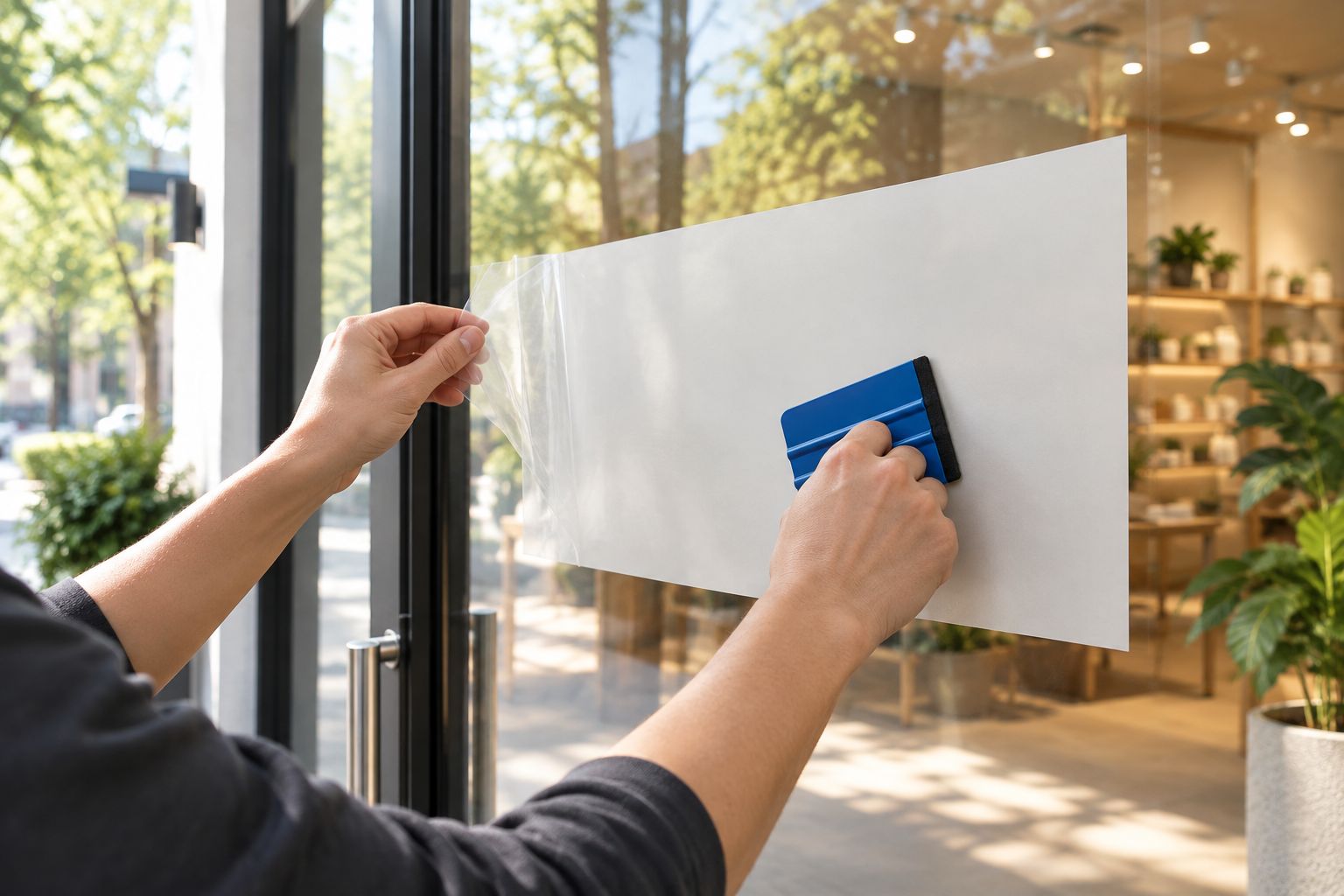
A No Soliciting door decal is a small, direct sign placed at or near the door telling salespeople, canvassers, and fundraisers the business isn't taking unscheduled pitches. It's a common fixture on small business doors in 2026, especially for offices and service shops that get interrupted mid-workday. The message is short by design, meant to be read in the two seconds someone spends standing at the entrance.
No Soliciting door decal pros:
No Soliciting door decal cons:
Best for: offices, salons, and small shops that get frequent unscheduled sales visits during business hours.
Verdict: Buy for any storefront that deals with regular walk-in solicitors; Skip if that's not a problem the business actually has.
An appointment-only door sign tells visitors upfront that the business doesn't take walk-ins, saving both sides an awkward conversation at a locked door. This matters more in 2026 than it used to, since more service businesses run lean schedules without front-desk staff to turn people away in person. The decal does that job before anyone tries the handle.
Appointment-only sign pros:
Appointment-only sign cons:
Best for: consultants, stylists, contractors, and other service businesses that book by appointment.
Verdict: Buy for appointment-based businesses; Skip for retail storefronts that need walk-in traffic. Appointment-only door signs covers wording options that keep the message friendly rather than curt.
A weatherproof exterior decal is vinyl rated to hold its color and adhesion through direct sun, rain, and temperature swings, which matters most on south- or west-facing storefronts with no awning. Standard indoor-grade vinyl fades and lifts faster in that kind of exposure. This category exists specifically for signage that has to survive outdoors year after year without a redo.
Weatherproof decal pros:
Weatherproof decal cons:
Best for: storefronts with south- or west-facing exposure and no awning or overhang.
Verdict: Buy for any exterior-facing signage; Hold for interior placements where standard vinyl already does the job. Weatherproof stickers breaks down which vinyl grades hold up longest outdoors.
A business door decal combines a logo, business hours, and sometimes a phone number into one compact panel placed directly on the entry door. It's the decal type most people picture when they think of storefront branding at the entrance itself, distinct from window lettering because it's smaller and carries more functional information than a name alone.
Business door decal pros:
Business door decal cons:
Best for: storefronts that want hours and contact info visible right at the door.
Verdict: Buy as a companion to window lettering, not a replacement for it.
A decal at the door only closes half the loop, though. People still have to find the storefront online before they ever read the sign in person, which is where physical signage and search visibility start overlapping. Pairing that door decal strategy with local SEO for small businesses is what actually gets someone from a phone search to standing in front of the glass reading it.


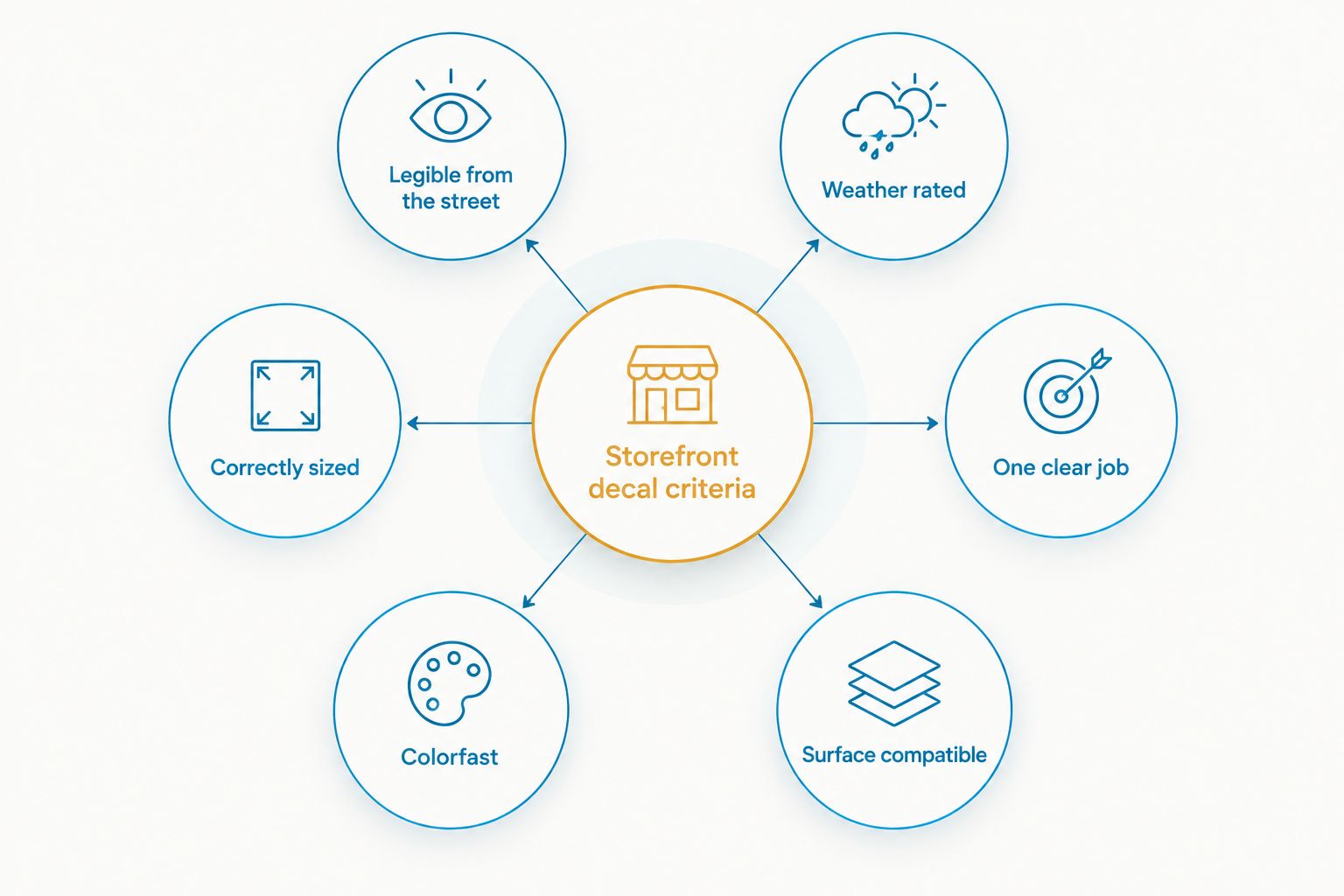
Each decal type above got weighed against the six criteria from earlier: legibility from the sidewalk, weather rating, one-job clarity, surface compatibility, colorfastness, and correct sizing. Custom window lettering wins overall because it clears all six for the broadest range of storefronts. No Soliciting and appointment-only signs rank where they do because they solve a narrower, sharper problem well rather than trying to do everything.
“If the message can't be read from the sidewalk, the decal isn't working.”
For most storefronts opening or refreshing signage in 2026, start with custom window lettering for the brand name, then add a No Soliciting or appointment-only decal only if that's an actual daily problem, not a hypothetical one. A weatherproof exterior decal earns its spot the moment any signage faces direct sun or rain with no awning overhead. Buying all five at once is rarely necessary; buying the wrong one first usually is the mistake that gets made.
What's the best company decal for a small storefront in 2026?
Custom window lettering with the business name and logo is the best overall company decal for a small storefront in 2026 because it's readable from the street and doubles as permanent branding.
Is a No Soliciting decal actually enforceable?
A No Soliciting decal sets a clear, visible expectation, but enforcement depends on local ordinances rather than the decal itself. Most businesses use it as a norm-setter, not a legal barrier.
How long does a vinyl company decal last outdoors?
An outdoor-rated vinyl decal holds its color and adhesion for several years under normal weather exposure. Direct south- or west-facing sun exposure shortens that timeline, which is why weatherproof-grade vinyl matters on unshaded storefronts.
Can a storefront have a window decal and a door decal at the same time?
Yes, and it's actually the better setup. Window lettering handles street-level branding while a smaller door decal handles hours, access rules, or contact info at the entry point.
Do appointment-only signs need to match the rest of the storefront branding?
Matching color and font to existing signage keeps an appointment-only sign from reading like an afterthought. It doesn't need to be identical, just consistent enough that it looks intentional.
What's the difference between a business window decal and a business door decal?
A window decal usually carries the business name or logo at a larger size for street visibility, while a door decal is smaller and often combines hours, branding, and contact info in one panel at the entrance.
Is custom vinyl lettering removable if the business rebrands?
It can be removed, but larger lettering applied for the long term sometimes leaves adhesive residue on glass. That's the tradeoff for a decal that reads as permanent signage rather than a temporary sticker.
How much text should a storefront decal actually carry?
One clear message per decal. A single decal trying to cover branding, hours, and an access rule at once usually ends up unreadable from more than a few feet away.
Most storefronts don't fail on decal design, they fail on decal overload: hours, logo, tagline, and phone number crammed onto one six-inch panel nobody can read from the sidewalk in 2026. Split it into three simple pieces instead: one decal for the brand, one for the access rule, one for hours. Three clean decals beat one crowded one every time, and each one still does its job when read from ten feet away instead of two.